





There’s a certain kind of truck buyer who has spent years browsing forums, pricing out ARB bumpers, researching Old Man Emu lift kits, and mapping out the total cost of building the overlanding rig of their dreams. Toyota just did all of that for them. The 2025 Tacoma Trailhunter showed up in my driveway for a week — March 11 through 18 — wearing Oxide Bronze Metallic with a Mineral interior, sitting on 33-inch all-terrain rubber, and carrying more factory-installed trail hardware than most trucks see after years of owner upgrades. The question wasn’t whether it looked the part. It absolutely does. The question was whether Toyota built something that actually earns its badge — or just sold us a very well-dressed costume.
After a week of desert backroads, highway miles, and a weekend that took us well past the point where paved roads existed, I have my answer.
Exterior Design
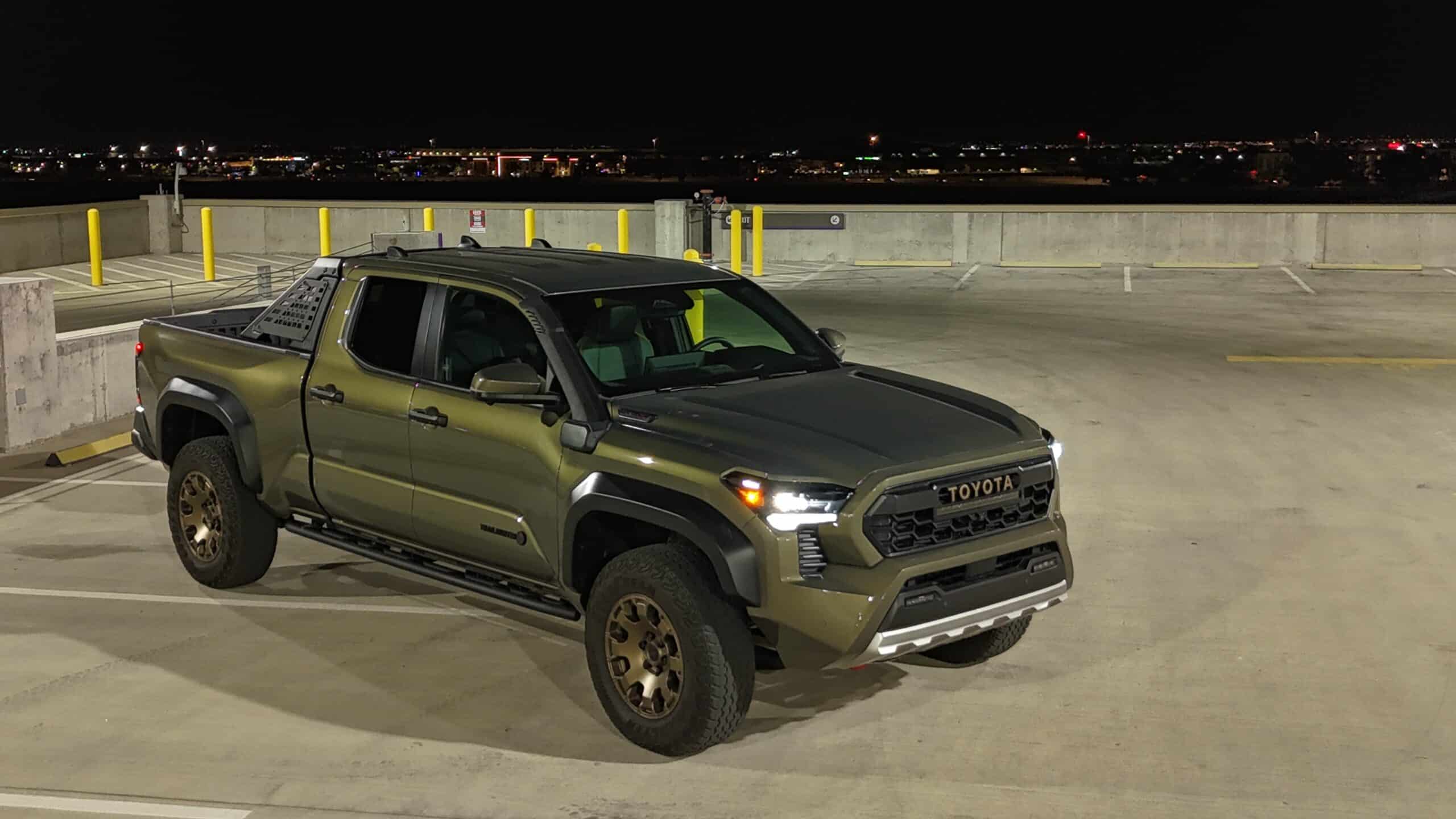
Let’s start with the obvious: the Tacoma Trailhunter is a head-turner, and not in a subtle way. The Oxide Bronze Metallic on this press vehicle is a rich, earthy tone that works perfectly with the truck’s blacked-out and bronze-accented theme. Up front, the Bronze Toyota Heritage Grille dominates the face, flanked by Trailhunter-signature LED headlamps and selectable LED fog lights. The integrated LED light bar sits tucked into the grille area, giving the front end a purposeful, wide-eyed look that reads as serious rather than theatrical.
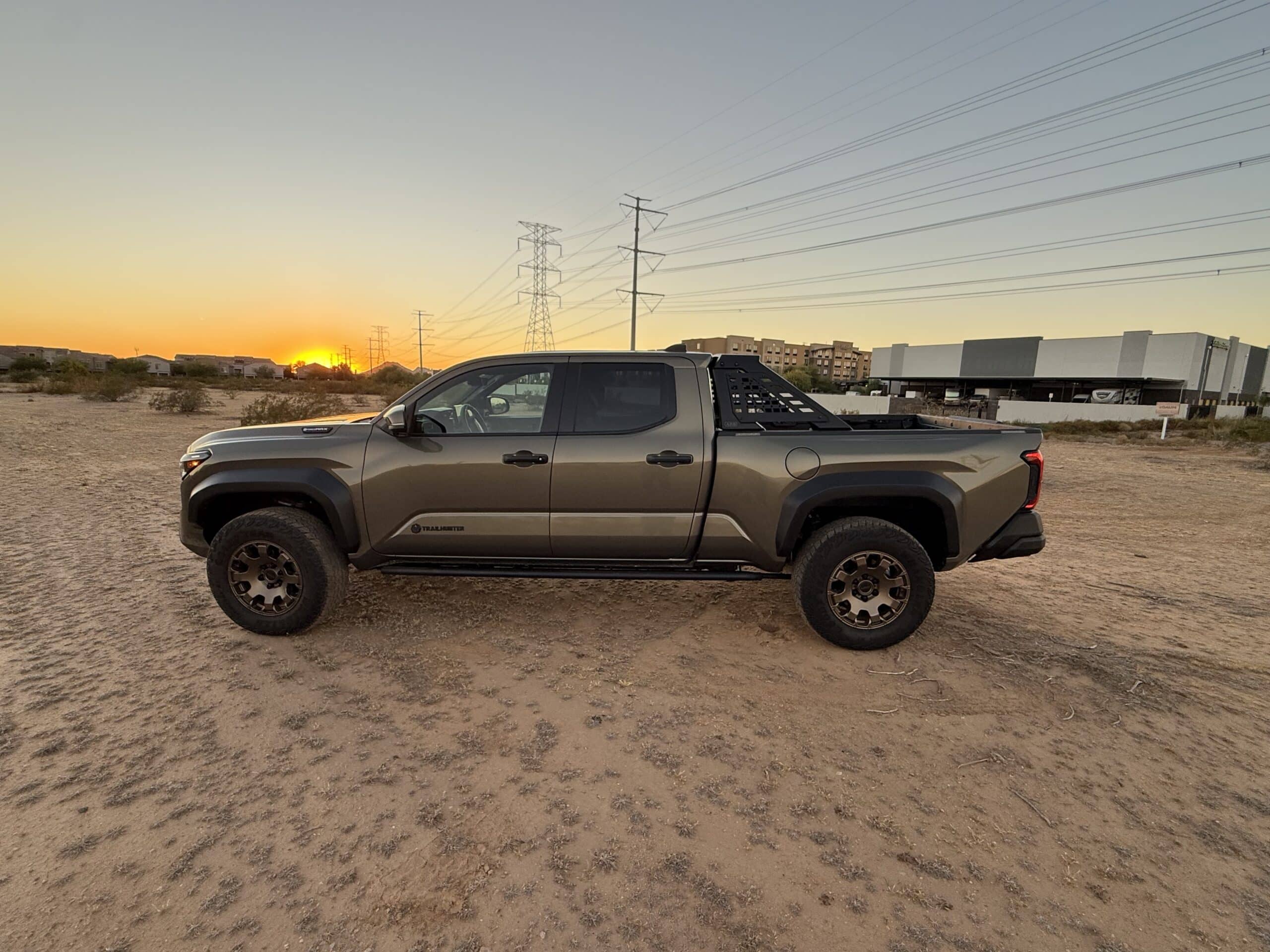
The 18-inch bronze-finished wheels are one of the best-looking factory wheel choices on any truck in this segment right now — they complement the Oxide Bronze paint perfectly while telegraphing the Trailhunter’s off-road intent. Frame-mounted rock rails run along the sides, protecting the rocker panels and giving the truck a hunkered-down, ready-for-anything stance. The ARB steel rear bumper with integrated recovery hooks at the corners is a detail that matters — it’s not decorative, it’s functional — and the power open/close tailgate is a welcome luxury touch in an otherwise rugged package.
At 6’4″ in the bed configuration on this test vehicle, proportions are excellent. It’s a big truck that wears its size honestly — no fake vents, no unnecessary cladding theater. What you see is what it does.
2025 Toyota Tacoma Trailhunter
Interior and Comfort
Inside, the Trailhunter is more comfortable than its trail-focused reputation might suggest, but it’s also more honest about its priorities than a luxury pickup would be. The SofTex-trimmed heated and ventilated front seats with lumbar support are genuinely supportive on long hauls, and the heated leather-trimmed steering wheel adds a comfort touch that doesn’t feel out of place here. The seating position is a notable improvement over the previous generation — upright, commanding, and properly truck-like without forcing you to feel like you’re perched on a workbench.
The 14-inch Toyota Audio Multimedia touchscreen is the centerpiece of the dash and, honestly, one of the better systems in the segment. It’s large, responsive, and logically organized. Wireless Apple CarPlay and Android Auto are standard, and the 12.3-inch digital gauge cluster gives the driver useful information in a clean, modern layout. The JBL 10-speaker audio system with subwoofer handles music duties competently, and Qi wireless charging keeps devices topped off without cable clutter.
Where things get real: the rear seat. It’s tight. There’s no way to sugarcoat it — legroom in the back of the Tacoma Double Cab is limited, and the fixed rear seat bottom means the folding seatback doesn’t create a flat load floor. Families with teenagers will feel this. It’s the Trailhunter’s most significant daily-driver compromise, and it’s worth knowing before you fall in love with everything else. That said, the center console cool storage and door pockets provide adequate everyday convenience, and the overall cabin quality is a genuine step forward from where the Tacoma used to be.
Powertrain
The Trailhunter is exclusively powered by Toyota’s i-FORCE MAX hybrid powertrain — a 2.4-liter turbocharged four-cylinder paired with an electric motor and a 1.87-kWh nickel-metal hydride battery. Combined output is 326 horsepower and a healthy 465 lb-ft of torque, routed through an 8-speed automatic and a part-time 4WD system with a two-speed electronically controlled transfer case. Before anyone rolls their eyes at the word “hybrid” on a truck: this powertrain earns its reputation immediately and repeatedly. The electric motor’s instant torque fills in exactly where a turbocharged engine would normally make you wait, and the result is a seamlessly responsive power delivery whether you’re on-ramp merging or crawling over rocks at walking speed.
The Monroney shows EPA-estimated fuel economy at 22 MPG city and 24 MPG highway, combined at 23 MPG — real-world returns that put it well ahead of non-hybrid competitors in this class. Over my week of mixed driving, I averaged just under that figure, which tracks. Towing capacity is rated at 6,000 pounds, which covers most overlanders’ trailer and toy-hauler needs comfortably.
Driving Experience
On the pavement, the Trailhunter rides with a firmness that’s honest about what it is. The Old Man Emu 2.5-inch forged monotube shocks with rear piggyback reservoirs are tuned for loaded overlanding and low-speed rock work — they resist body roll confidently and control weight transfer well, but they communicate road texture more directly than a comfort-tuned suspension would. It’s not punishing, but it’s not a luxury ride. Highway manners are composed, and the steering, while deliberate rather than sporty, is accurate enough to inspire confidence on winding backroads.
Off the pavement is where this truck finds its reason for being. The Stabilizer Disconnect Mechanism — which decouples the front sway bar at low speeds to improve wheel articulation — genuinely changes the character of the truck on technical terrain. Combined with the electronically controlled locking rear differential, Crawl Control, and Multi-Terrain Select (with modes for rock, mud, sand, dirt, and deep snow), the Trailhunter attacks obstacles with a calm, systematic competence that’s genuinely impressive. The high-mounted A-pillar snorkel isn’t just a visual statement — it raises the air intake for water crossings and keeps dust out of the intake on dry, powdery trails. The factory air compressor means you can air down for the trail and back up for the drive home without carrying extra gear.
The ARB rear bumper and Rigid Industries white/amber selectable LED light bar are the kinds of details that separate this truck from the typical off-road trim package. Toyota didn’t build a trail-themed Tacoma — they built a factory overlanding rig and put a Tacoma badge on it.
Safety and Technology
Toyota Safety Sense 3.0 covers the standard bases: Pre-Collision System with Pedestrian Detection, Star Safety System (including traction control, stability control, ABS, and brake assist), Blind Spot Monitor with Rear Cross-Traffic Alert, and Connected Services capability through Toyota’s 4G network-dependent platform. A Panoramic View Monitor is included as part of the standard equipment package, which proves genuinely useful both on-trail for checking rock placement and in parking lots where the truck’s sizable footprint requires attention.
The Towing Technology Package on this particular unit — a $850 option per the Monroney — adds Toyota Wireless Camera System (WCS), Courtesy Delivery Veh/TMS/NFS coverage. The overall safety suite is well-rounded and works without being intrusive.
Who Is This For?
The Tacoma Trailhunter has a distinct buyer profile, and it’s worth naming clearly. This truck is purpose-built for the outdoor enthusiast who wants maximum trail readiness without the time, expense, or guesswork of building it themselves. It suits the weekend overlander who runs trails on Saturday and drives to the office on Monday — someone who values capability over luxury, but doesn’t want to give up modern conveniences like wireless CarPlay and ventilated seats. It’s also ideal for buyers who camp, hunt, or fish regularly and need a truck that functions as a mobile basecamp. Families are welcome, but rear-seat comfort is the honest trade-off. If you prioritize interior space and daily passenger comfort, the 4Runner Trailhunter is worth a cross-shop. If you need the bed and the trail capability above all else — this is the one.
Pricing and Final Thoughts
Per the Monroney, this 2025 Toyota Tacoma Trailhunter 4×4 Double Cab carries a base MSRP of $63,235. Add the Towing Technology Package ($850), Spray-On Bed Liner ($575), Door Panel Scuff Protector ($135), Ball Mount ($70), and Mini Tie-Down ($45), and the total as-equipped price is $66,405, including the $1,495 Delivery, Processing and Handling Fee.
That’s a serious number for a midsize truck. But when you itemize what Toyota has included from the factory — ARB bumpers and recovery hooks, Old Man Emu suspension, a factory air compressor, skid plates, rock rails, a snorkel, a bed inverter, and a hybrid powertrain with 465 lb-ft of torque — the value math starts working in its favor. Buying an equivalent off-road truck and building it to this spec with aftermarket parts would cost significantly more, and likely take months longer.
After a week, I came away genuinely convinced that Toyota built something real here. The Trailhunter isn’t marketing. It’s a truck that knows exactly what it is, does exactly what it claims, and does it with a level of factory integration that raises the bar for the segment. The overlanding crowd has been waiting for something like this for years. Toyota finally delivered.