


This week, I spent time with the refreshed 2025 Mitsubishi Outlander SEL, a smartly sized SUV that sits somewhere between compact and midsize. It is an interesting crossover that occupies a unique space in the market—larger than typical compact SUVs yet smaller than true midsize offerings.
Mitsubishi redesigned the Outlander from the ground up in 2022, and for 2025 it continues to evolve with sharper details, new tech, and a more refined interior.
Technically, it’s a three-row vehicle, but in reality, it functions best as a roomy two-row SUV with a generous cargo hold. You could squeeze a couple of small kids or maybe a dog into that third row, but most buyers will keep it folded for storage. Built on the same platform as the Nissan Rogue — the two share several components — the Outlander retains its own identity with a bolder design, distinctive personality, and Mitsubishi’s signature all-wheel-drive capability.
For 2025, the refresh brings updated styling cues, enhanced interior materials, and perhaps most notably, a collaboration with Yamaha on the audio system that genuinely changes the in-cabin experience. But does substance match style? A week of real-world driving provided ample opportunity to evaluate this question.
Exterior Design
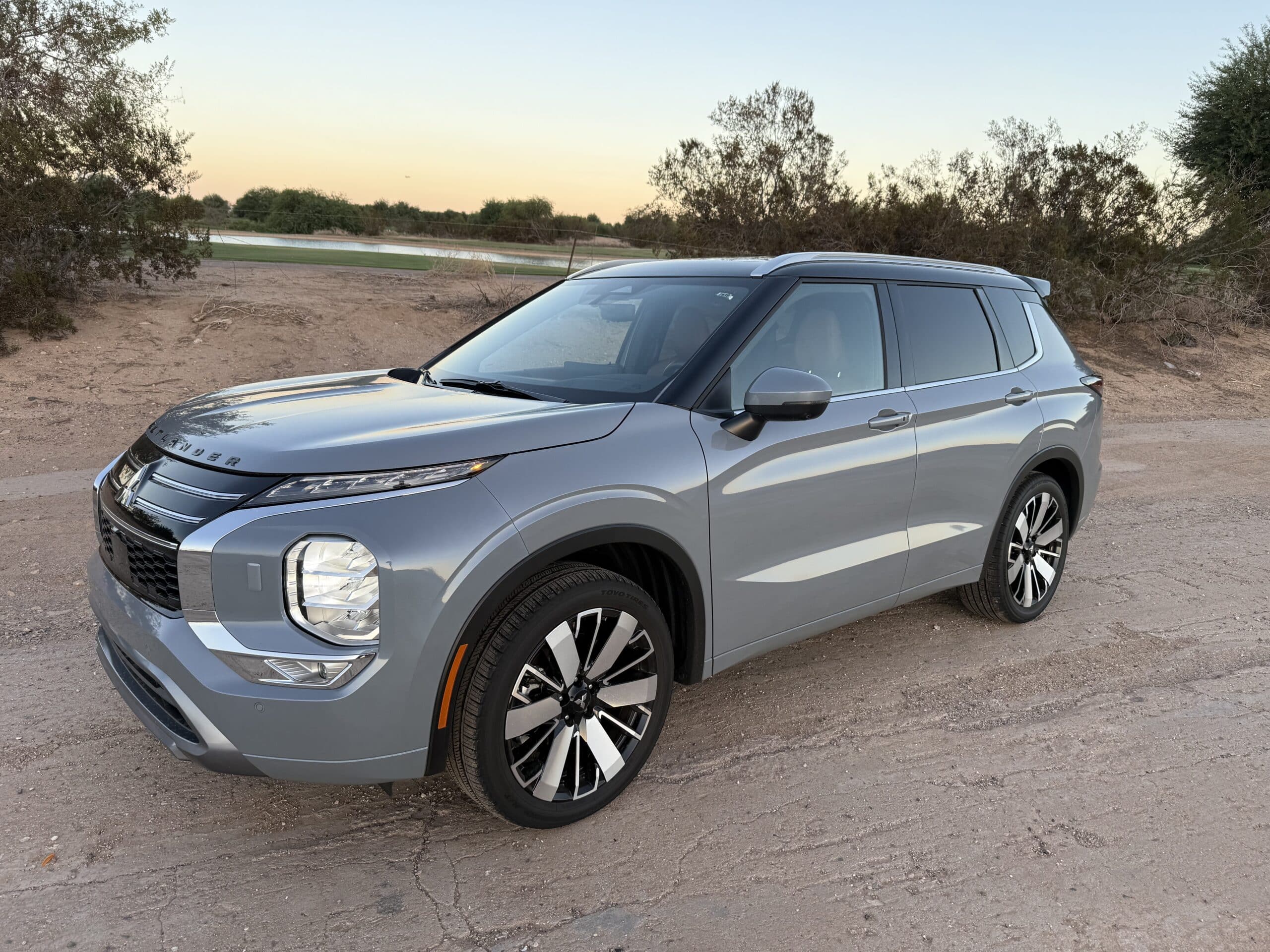
The Outlander’s exterior styling did catch my attention, particularly in the Moonstone Gray Metallic finish paired with the contrasting black roof—a color combination that’s gained significant popularity lately for good reason. Mitsubishi did a great job on the design and I think this is something that will appeal to a broad range of drivers.
The front end makes a bold statement with LED driving lights positioned above the LED headlights. The prominent chrome grille commands attention, while character lines flow cleanly along the bodysides. One distinctive element is the flat roofline—uncommon in today’s market where most designs slope rearward—which works well with the substantial rear spoiler.
The 20-inch chrome wheels with black accents stand out as particularly well-executed. The wheels really add that extra something that really add to the curb appeal.
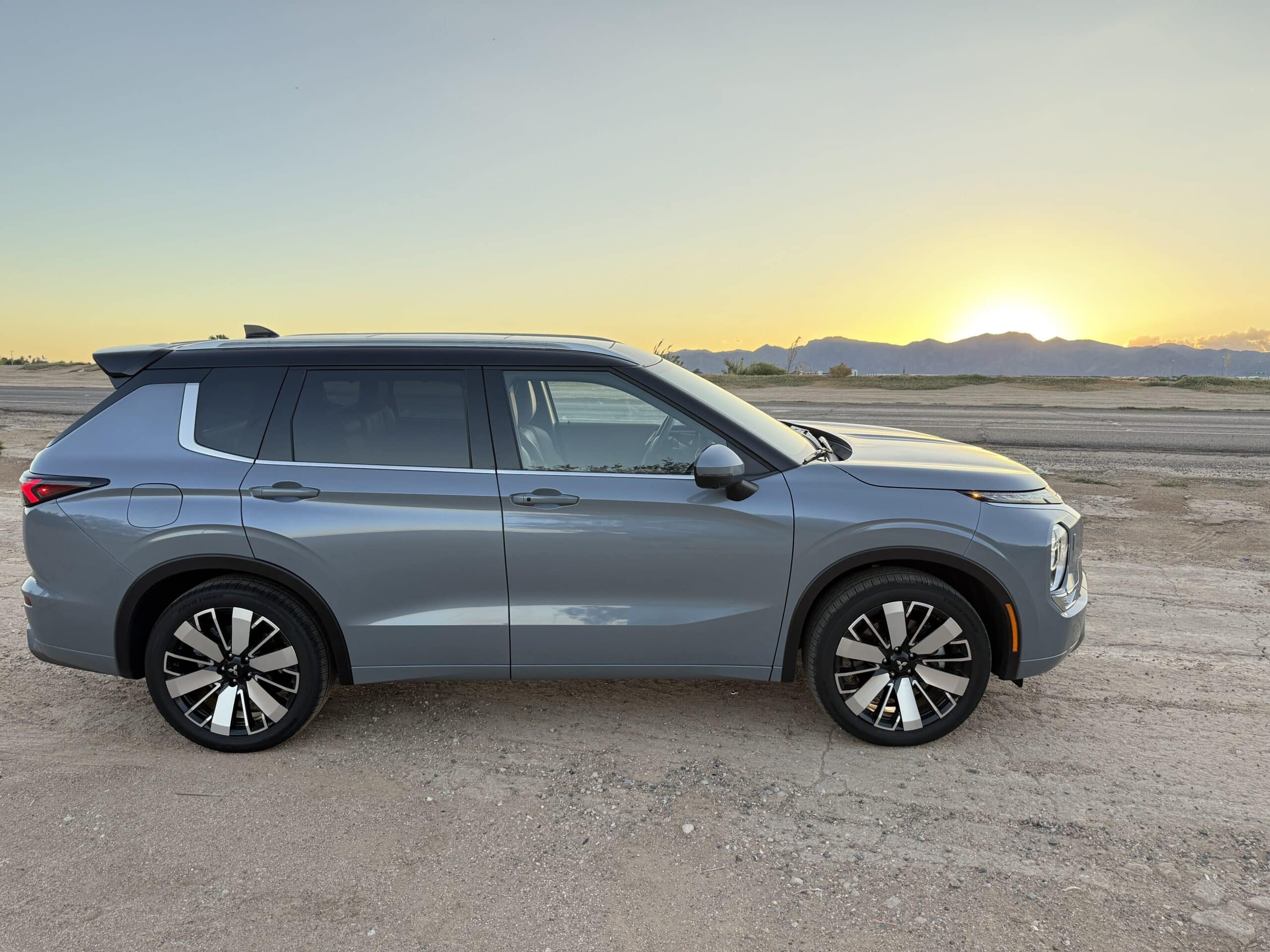
2025 Mitsubishi Outlander
Interior
The interior is where the Outlander SEL truly delivers. The interior quality exceeds expectations for this price point, with materials and finishes that compete with more expensive competitors. The SEL trim is just below the range-topping Platinum edition, yet it’s difficult to imagine how the interior could meaningfully improve beyond this trim level.
The leather seats combine visual appeal with genuine comfort, featuring diamond-quilted patterns that coordinate with the door panel treatments. Contrast stitching appears throughout, including across the dashboard. The Brick Brown interior creates a rich, upscale atmosphere. I love leather seats and the seats are as comfortable as they are beautiful.
Pressing the start button activates a 12.3-inch digital instrument cluster that combines modern digital displays with traditional analog-style gauge layouts. The display includes a multi-information screen, digital speedometer, outside temperature reading, and configurable alerts for safety systems and drive modes. The display is well-positioned with no glare problems, making it easy to read at a glance. The center console is well designed, housing the gear selector, drive mode rotary dial, auto hold button, wireless charging pad, and USB connections.
Above the console sits a 12.3-inch touchscreen managing audio, navigation, Bluetooth connectivity, Wi-Fi, real-time information services, and wireless Apple CarPlay and Android Auto integration. The system responds quickly, operates intuitively, and is smart and functional. Camera resolution is crystal-clear with cross-traffic detection.
Second-row passengers benefit from thoughtfully designed seatback pockets that include dedicated cell phone storage. Additional amenities include heated seats, independent temperature controls, both USB-A and USB-C ports, plus seats that slide and recline for customized comfort.
The interior design has generated considerable enthusiasm in online forums and reviews, and after a week with the vehicle, I can see why.
Performance
Power comes from a 2.5-liter, naturally aspirated four-cylinder producing 181 horsepower and 181 lb-ft of torque, paired with a continuously variable transmission (CVT) that simulates gear shifts through a stepped programming. Mitsubishi’s CVT seems better behaved than most. It mimics traditional gear changes well, and you can even feel a difference when using the paddle shifters.
My test vehicle came equipped with Super All-Wheel Control (S-AWC), Mitsubishi’s sophisticated AWD system that manages torque distribution between the wheels for better stability and grip. Power delivery is smooth and predictable, and it’s capable enough for light off-road duty — unpaved roads, gravel, uneven surfaces— all handled with calm confidence.
A rotary drive mode selector behind the shifter lets you toggle between Eco, Normal, Tarmac, Gravel, Snow, and Mud. “Tarmac” acts as a subtle sport mode, tightening throttle response and steering just enough to make spirited driving a bit more engaging.
Acceleration won’t push you back in your seat, but it’s adequate for everyday driving. The 2.5-liter engine gets the job done efficiently, returning an EPA estimate of 24 mpg city and 30 mpg highway. If you want a livelier experience, Mitsubishi’s plug-in hybrid (PHEV) version offers stronger performance and exceptional efficiency — and it’s not much more expensive.
Standard Equipment
The Outlander SEL comes comprehensively equipped from the factory with three-zone automatic climate control, power panoramic sunroof with power sunshade, 8-way power driver seat with memory function and 4-way power passenger seat, heated and ventilated front seats, heated rear seats, heated steering wheel, leather upholstery, aluminum pedals, front parking sensors, rear privacy glass, capless fuel filler, LED lighting throughout, roof rails, one-touch up/down power windows, pushbutton start via FASTKey, remote keyless entry, auto-dimming rearview mirror, manual tilt-and-telescoping steering column, and an 8-speaker Yamaha premium audio system.
Yamaha Sound System
This was my first time experiencing Mitsubishi’s collaboration with Yamaha on an automotive sound system — and it’s impressive. The setup uses 12 speakers, including a subwoofer, powered by dual amplifiers producing roughly 1,650 watts. The clarity and balance are excellent, with selectable modes like Signature, Lively, Powerful, and Relaxing.
To complement the audio upgrade, Mitsubishi worked to reduce cabin noise levels significantly. The result is a quiet, serene interior that makes the most of the Yamaha system. Even at highway speeds, there’s minimal wind or road noise, giving the Outlander an unexpectedly premium driving experience. There is a particular stretch on the 202 Freeway between Scottsdale and Phoenix that is really loud and this is where I test road noise. I can say the Outlander passed with flying colors.
Safety Equipment
Safety technology comes standard with forward collision mitigation, blind spot monitoring, rear cross-traffic alert, lane departure warning, lane keep assist, adaptive cruise control, driver attention monitoring, and automatic high beam headlights. The structure employs RISE (Reinforced Impact Safety Evolution), Mitsubishi’s advanced safety body construction combining robust high-tensile steel cabin reinforcement with engineered crumple zones that absorb and redirect crash energy away from occupants, effectively creating a reinforced protective shell around the passenger compartment.
Driving Dynamics
The Outlander is really easy to drive, especially easy to park and reverse as well. The Tarmac mode does provide better handling and tighter steering capabilities. Acceleration is adequate and good enough for most drivers shopping this category of vehicle. While performance leans more toward practical than thrilling, the benefit shows up at the pump — the Outlander returns a respectable 24 mpg city, 30 highway, and 26 combined.
Pricing and Value
The as-tested MSRP came in at $45,930 fully equipped—a genuinely compelling value proposition for a generously equipped SUV offering substantial cargo capacity. The value equation improves further when considering the included 10-year/100,000-mile powertrain warranty and two years of complimentary maintenance.
Conclusion
The 2025 Outlander SEL makes a strong case as a practical, comfortable daily driver that delivers more than its price tag suggests. With its quality interior, comprehensive feature set, and outstanding warranty coverage, it competes effectively in a crowded segment. While the third row limits its appeal as a true seven-seater, families needing five seats and generous cargo space will find this SUV hits the mark. Worth noting: the plug-in hybrid version offers improved performance without a significant price increase, making it worth a test drive for those interested in the platform.
For the official word and all things Mitsubishi Outlander visit the link below as follows:
https://www.mitsubishicars.com/cars-and-suvs/outlander