




Most Americans were introduced to Aston Martin through James Bond. Over six decades of films, different models, the DB5, the V8 Vantage Volante and the DBS, have carried Bond’s name from the screen into the showroom, and that legacy is baked into how the brand gets talked about here even now. But sit in on a real conversation among people who are actually making a decision between a Ferrari, a Lamborghini, or an Aston Martin, and the debate sounds nothing like a movie poster. Nobody is arguing about which car looks the most expensive. They are arguing about which car says the least while doing the most.
That is where the Vantage Roadster lives. A Ferrari or a Lamborghini exists to be noticed. They are built for the walk up, the reveal, the moment someone’s head turns in a parking lot. Aston Martin was never trying to win that game. This is the car for someone who has already made their point and does not need the exhibit. You do not buy a Vantage to prove anything to the valet.
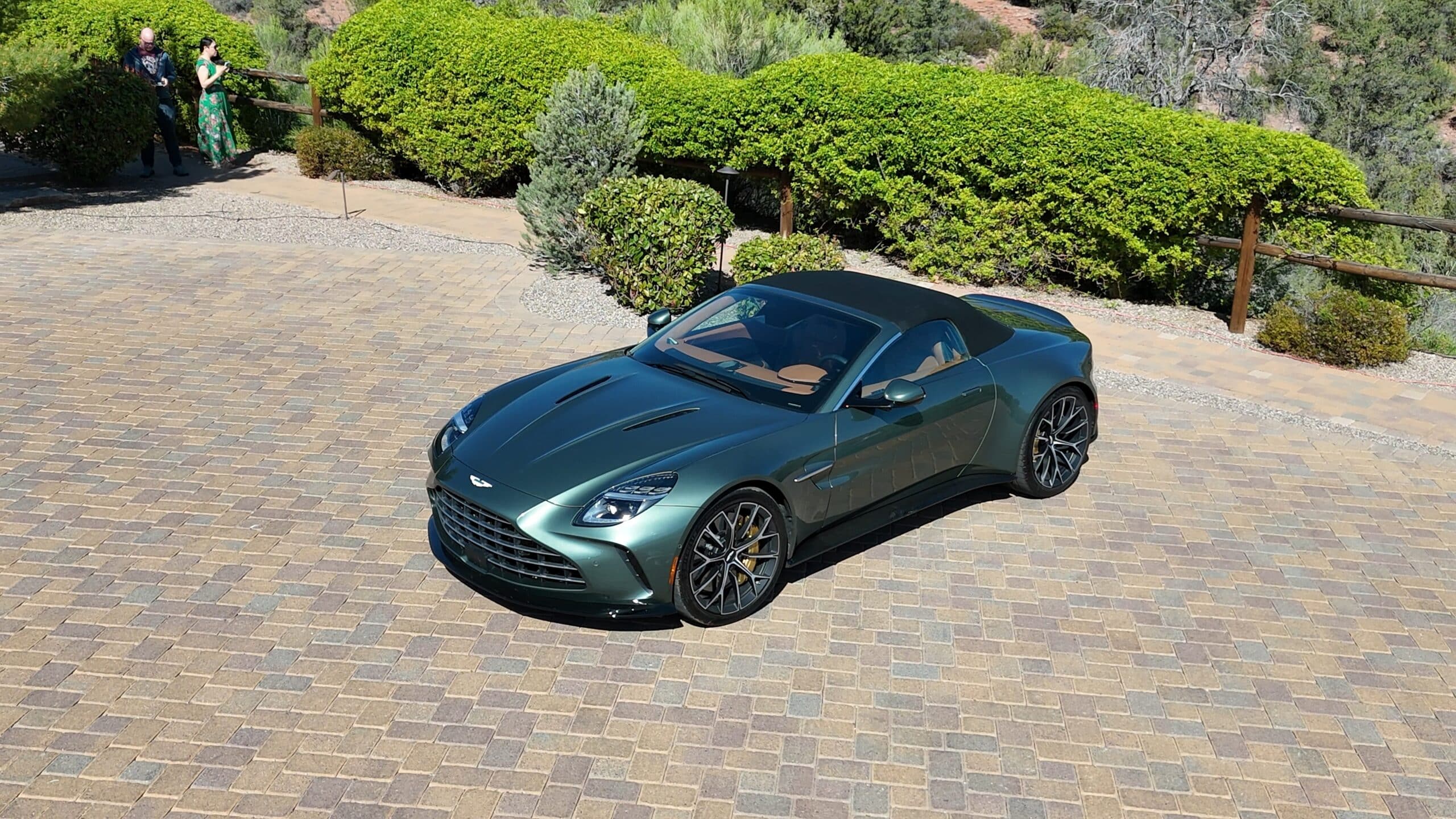
You buy it because the drive proves plenty on its own, and once you have felt what it can do, that difference stops being a talking point and becomes the entire argument. I found that out on the mountainside outside Jerome, overlooking Sedona, with the roof down and nowhere else I needed to be. The fabric top opens in 6.8 seconds at speeds up to 31 mph, which Aston Martin says makes it the quickest power operated roof on the market, so dropping it mid drive becomes second nature instead of a production. That is not an accident. The Roadster was developed alongside the coupe from day one rather than adapted from it afterward, and it shows in how solid the car feels with the top gone and in how differently the exhaust was tuned to sound with the wind coming through.
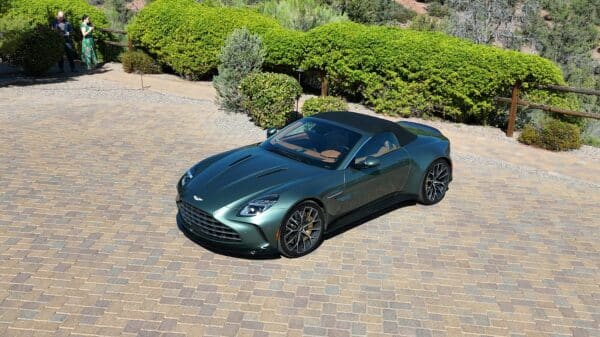
Through those switchbacks outside Jerome, the weight sits low and settles into each corner instead of leaning against it, and the rear stays planted through direction changes that would have most cars hunting for grip. The electronic rear differential and torque vectoring are doing real work here, feeding power to the outside wheel through the apex so the car rotates instead of pushing wide, and the steering telegraphs exactly how much grip is left before you ever need to find out the hard way. The engine note echoing off the canyon walls is something I am still thinking about. This is the part a Ferrari or Lamborghini buyer should actually pay attention to. Those brands sell you a reputation for handling. The Vantage just hands you the result, without asking you to explain the badge first. Chiltern Green runs an additional $20,000 as a standalone paint option, and it earns every dollar the moment light hits it. Curb appeal was never really in question with this car, but I did not expect it to hold my attention for the entire week the way it did.
Most owners in this price range drive their Ferrari or Lamborghini once a week and let it sit the rest of the time, because a car built to be seen asks something of you every time you take it out. This car does not ask that. It pulls you back behind the wheel for the drive itself. Drive it for a week and see where Ferrari and Lamborghini land on your list after that.
Highlights
The real highlight of the week was the drive through the switchbacks outside Jerome, roof down, exhaust bouncing off the canyon walls. This is one of the best cornering cars I have ever driven. Most cars in this class make you feel the gravity working against you through a fast turn. This one lets you feel it and stay glued to the road anyway, the electronic diff and torque vectoring doing the work underneath while the steering keeps you in on exactly how much grip you have left.
The roof still opens at 31 mph and the ease of dropping it on the fly meant I actually used it, which changed the whole experience of the week.
By the end of the week I understood why anyone with the means to own this car would buy it the moment they drove it this way. It was the drive of a lifetime, and every other detail in this review, the paint, the wheels, the interior, is a footnote next to that.
Driver Experience
The hand assembled 4.0 liter twin turbocharged V8 produces 656 horsepower and 590 lb ft of torque. Aston Martin retained full control over the tuning of this AMG sourced engine, specifying their own intake, turbochargers, exhaust, and firing order. The result is an engine that sounds and behaves entirely like an Aston Martin, not a badge swap. Power increases of 153 horsepower and 85 lb ft of torque over the previous generation are numbers that demand attention, and the car delivers on every one of them.
Five selectable drive modes, Sport, Sport Plus, Track, Wet, and Individual, give you meaningful control over how the Vantage presents itself. Sport is where most driving happens. Track is where you understand what the engineers were actually thinking. The electronic rear differential and Dynamic Torque Vectoring work together to give the car a balance between grip and playfulness that is rare in this segment. Steering is communicative and precise, every corner an invitation.
The Vantage hugs the road so completely that I felt I could take the switchbacks and steep mountain turns around Jerome and Sedona as fast as I wanted. You feel the gravity working in those turns, but the Vantage stays glued to the pavement and simply performs.
The 8 speed automatic transmission is rear mid mounted, which contributes to the near perfect weight distribution that makes the Vantage feel smaller and more responsive than its 3,900 pound curb weight suggests. The carbon ceramic brakes with gold painted calipers provide stopping power that matches the performance numbers. You never question whether the car can slow down as quickly as it accelerates. It can.
The 2026 Aston Martin Vantage Roadster
Interior
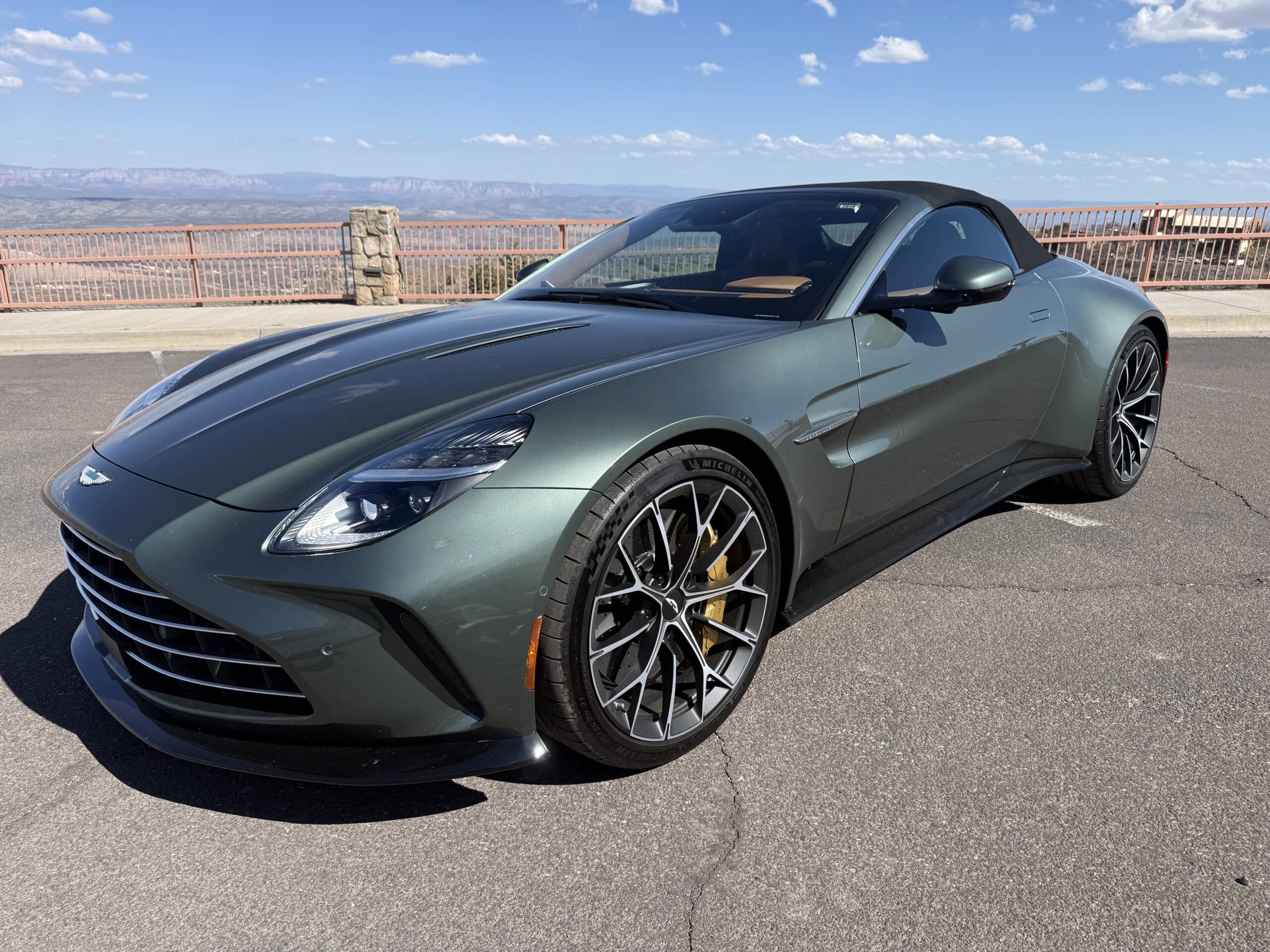
The Centenary Saddle Tan semi aniline leather is one of the more striking interior choices available on the Vantage, and in person it is even more impressive than photographs suggest. The Inspire Sport Monotone interior package gives the cabin a focused, purposeful character without sacrificing the handcrafted luxury that Aston Martin has built its reputation on. Every surface you touch confirms that this vehicle was assembled by people who take their craft seriously.
The Interior Jewellery Pack in Satin Dark Chrome, Contrast Stitching in Obsidian Black, and the Heated Steering Wheel are details that reveal themselves gradually as you spend time in the car. The 10.25 inch TFT touchscreen central display and 10.25 inch TFT driver information display are current and well integrated without dominating the interior aesthetic the way some competitors allow technology to overwhelm the cabin character.
The Bowers and Wilkins audio system is genuinely excellent. With the roof down and the volume up, it competes with the exhaust note rather than surrendering to it, which is the correct relationship between audio system and engine sound in a car like this.
Exterior
The Vantage Roadster was developed alongside the coupe from day one, and this is the first full model year the car will be sold stateside. The exterior carries the full reinvention of the second generation Vantage, including a complete styling refresh, and the Roadster adds a visual drama that the coupe cannot replicate. The proportions are correct. The long hood, the short overhangs, the muscular rear haunches, and the open cockpit all read as intentional rather than compromised by the conversion from fixed roof to fabric top.
Chiltern Green at $21,600 as a standalone option is a meaningful investment in color, and it justifies every dollar. This is a shade with character and depth that changes throughout the day in Arizona light and would photograph well in any setting. The smoked rear lamps and the black exterior pack details give the rear of the car a presence that is understated at low speeds and dramatic at anything above them.
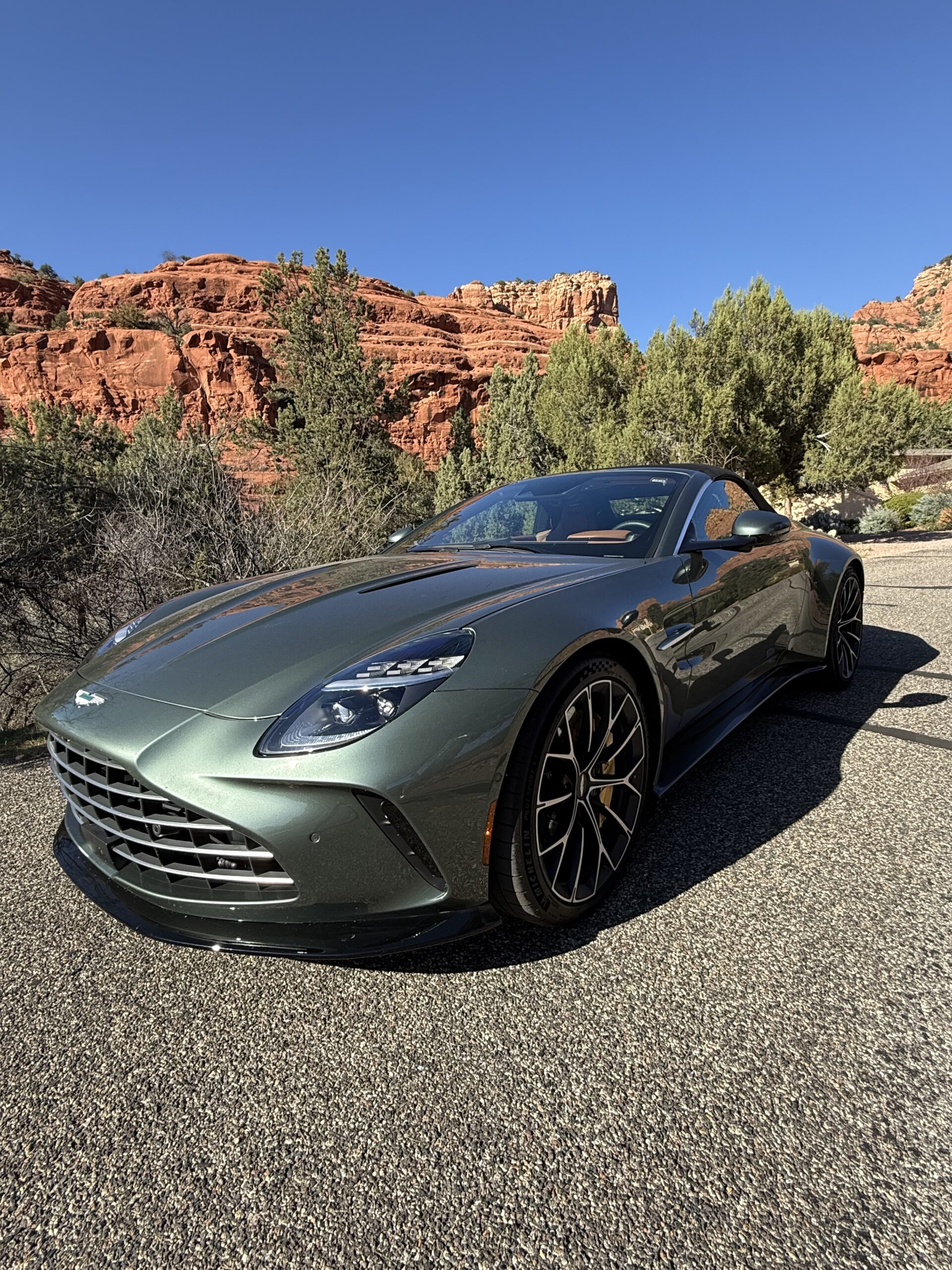
The 2026 Aston Martin Vantage Roadster Sedona Red Rocks
Engine / Powertrain
The 4.0 liter twin turbocharged AMG sourced V8 produces 656 horsepower at 6,000 rpm and 590 lb ft of torque at 2,750 rpm. The 8 speed automatic transmission is rear mid mounted through a transaxle configuration that achieves the balanced weight distribution the Vantage’s handling character requires. The Vantage accelerates to 60 mph in 3.3 to 3.4 seconds and reaches a top speed of 202 mph.
At 18 MPG combined, the Vantage Roadster is not going to win any efficiency awards, and at 656 horsepower it was never supposed to. Drive it the way it wants to be driven and you will burn through fuel and enjoy every single mile of it. Nobody shopping for a car like this is doing the math on fuel costs, and frankly, the engine makes sure of that.
Safety
Dynamic Stability Control, Traction Control, and Positive Torque Control are standard. Dual stage driver and passenger front airbags and seat mounted and curtain side impact airbags are included. Lane Keep Assist and Autonomous Emergency Braking round out the active safety suite. For a vehicle in this segment and at this price, the safety equipment is appropriate and present without being intrusive to the driving experience.
The biggest safety feature that stood out for me was the ability to stop on a dime at higher speeds with eloquence.
Conclusion
The 2026 Aston Martin Vantage Roadster is one of those rare vehicles that lives up to what it promises before you ever start the engine. The color combination is exceptional. The interior quality is what you expect from a hand built British sports car at this price, and then a little more. The 656 horsepower twin turbo V8 is spectacular in character and in execution. And with the roof down, the exhaust note tuned specifically for open air driving filling the cabin, you are reminded of exactly why cars like this exist.
Seventy five years after the first Vantage badged DB2, and twenty years since the Gaydon era V8 reshaped the brand’s future, this new Roadster is a true heir to Aston’s open top lineage. It earns that heritage.